Why You Forget Everything (And How to Fix It)

Have you ever spent hours studying, only to find that most of the information vanished by the next morning? This isn't a lapse in intelligence; it's a fundamental physiological process of the human brain. However, cognitive science has unlocked the secret to overriding this "delete" button, allowing us to cement knowledge into our Long-term Memory.
In this deep dive, we explore the mechanics of the Forgetting Curve, the evolution of Spaced Repetition, and how the cutting-edge FSRS algorithm is revolutionizing the way we retain information.
1. Hermann Ebbinghaus and the Discovery of the Forgetting Curve
In 1885, German psychologist Hermann Ebbinghaus conducted a series of groundbreaking experiments to quantify the rate at which humans lose information. By memorizing "nonsense syllables," he measured his "savings score"—the decrease in time required to relearn material over time.
The Brutal Truth of Memory Decay
Ebbinghaus's data revealed that memory decay follows an exponentially downward curve:
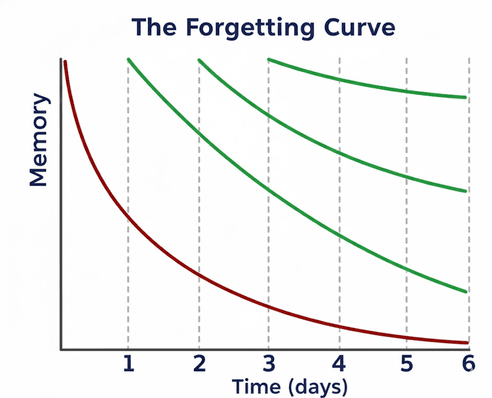
- After 20 minutes: 42% of the information is lost.
- After 1 hour: 56% is gone.
- After 1 day: 66% has vanished.
- After 1 month: Only about 20% remains.
The key takeaway is that forgetting is fastest immediately after learning. Therefore, the first 24 hours are the "golden window" where the right intervention can determine the lifetime of a memory.
2. The Neuroscience of Memory: Synaptic Plasticity and the Power of Recall
To beat the curve, we must understand how the brain stores data.
Synaptic Plasticity & Long-Term Potentiation (LTP)
Our brain cells (neurons) communicate through gaps called synapses. When we repeatedly stimulate a specific piece of information, the connection between these neurons physically strengthens—a phenomenon known as Long-Term Potentiation (LTP). Reviewing based on the Forgetting Curve is essentially "re-wiring" these connections just as they begin to fray, making them thicker and more resilient each time.
The Active Recall Effect
Passive review—like re-reading a textbook—is merely "recognition," not learning. Active Recall, the process of forcing your brain to retrieve information from memory, is what creates the strongest neural signals. This is why Flashcards are so effective; they demand a high-effort retrieval that signals to the brain: "This information is vital—keep it."
3. Spaced Repetition: The Art of "Desirable Difficulty"
The most powerful weapon against the Forgetting Curve is Spaced Repetition.
Desirable Difficulty
Coined by Professor Robert Bjork, this concept suggests that learning is most effective when it is challenging. Reviewing information just as you are about to forget it—when the effort to recall is at its peak—maximizes the chances of that information moving into long-term storage.
The Spacing Effect: By progressively increasing the intervals between reviews, you significantly increase the Stability of the memory while minimizing the total time spent studying.
4. The Evolution of Algorithms: From SM-2 to FSRS
In the digital age, we no longer have to manually track these intervals. Algorithms do it for us, and they have become incredibly sophisticated.
SM-2 (SuperMemo-2)
Developed in the late 1980s, SM-2 is the "grandfather" of spaced repetition. It uses a fixed multiplier (the Ease Factor) to calculate the next review date based on your self-reported difficulty.
- Pros: Simple and proven effective for decades.
- Cons: It treats every learner's brain the same and struggles to adapt to the early stages of learning or varying levels of complexity.
FSRS (Free Spaced Repetition Scheduler)
FSRS is the next-generation, open-source scheduler based on the DSR Model, which tracks three key metrics:
- Difficulty: How inherently complex is the information?
- Stability: How long will this memory last before being forgotten?
- Retrievability: What is the probability of you recalling this information right now?
Unlike SM-2, FSRS analyzes millions of data points from real-world learners to create a personalized memory model. Research indicates that FSRS can achieve the same retention rates as SM-2 but with 20-30% fewer reviews, drastically reducing "study fatigue." Flica has FSRS built-in from the start, so you get optimal review timing without any complex setup.
5. Principles for Effective Flashcard Creation
To make the most of any spaced repetition system, follow these core principles:
The Minimum Information Principle
Each card should contain one question and one specific answer. Complex cards confuse the brain and lead to "interference."
Understand Before You Memorize
Never memorize something you don't understand. Spaced repetition is for retention, not for comprehension.
Consistency is Key
The Forgetting Curve never sleeps. The system only works if you complete your "Daily Reviews" to hit those optimal windows of recall.
6. FAQ: Myths vs. Reality
Q: Isn't it better to review every day?
A: Surprisingly, no. Over-reviewing (cramming) makes the brain lazy. You need the "gap" to create the "desirable difficulty" that triggers long-term storage.
Q: Is FSRS worth the switch for a casual learner?
A: Absolutely. While it shines for high-volume learners (like medical students or polyglots), its ability to optimize study time benefits anyone who wants to learn faster with less effort.
Q: Does age affect the Forgetting Curve?
A: While the speed of initial "Encoding" might vary, the mechanics of "Decay" remain consistent. Spaced repetition is an equalizer that helps learners of all ages maintain high retention.
7. Conclusion: The Compound Interest of Knowledge
Forgetting isn't a flaw; it's a feature of a brain that tries to stay efficient. By using the Forgetting Curve and FSRS algorithms, we aren't just studying harder—we are studying smarter by hacking our own biology.
Knowledge, much like capital, compounds over time. The 10 minutes you spend reviewing today will pay dividends in clarity and insight years down the road. Embrace the science of learning and turn your fleeting thoughts into lifelong knowledge.
Related Articles
References & Academic Sources
- Ebbinghaus, H. (1885). Memory: A Contribution to Experimental Psychology.
- Bjork, R. A. (1994). Memory and Metamemory considerations in training.
- Ma, J., et al. (2023). A Open-source Spaced Repetition Scheduler based on DSR Model.