Why Your Brain Needs FSRS (Not SM-2)

If you've ever used Anki or any flashcard app, you've probably experienced this: you study hard, but the app keeps showing you cards at weird times. Sometimes too early (you still remember it perfectly), sometimes too late (you've already forgotten). That's because most apps use an algorithm from 1987 called SM-2. It works, but it's outdated. FSRS (Free Spaced Repetition Scheduler) is the upgrade we've been waiting for.
FSRS learns how YOUR brain works and schedules reviews at the perfect moment—right before you forget. The result? Same retention, but 20-30% fewer reviews. Less grinding, more learning.
1. What is FSRS?
FSRS is a new open-source algorithm that predicts when you'll forget something. It was built by analyzing 700 million flashcard reviews from real users. Instead of using the same schedule for everyone, FSRS builds a custom model for YOUR memory. It tracks three things for every card:
The DSR Model
Every card in FSRS has three numbers that describe your memory of it:
- Difficulty (D): How hard is this card for you? Some facts are just harder to remember. FSRS figures out which cards YOU struggle with.
- Stability (S): How long until you forget? High stability = you can wait weeks before reviewing. Low stability = review soon.
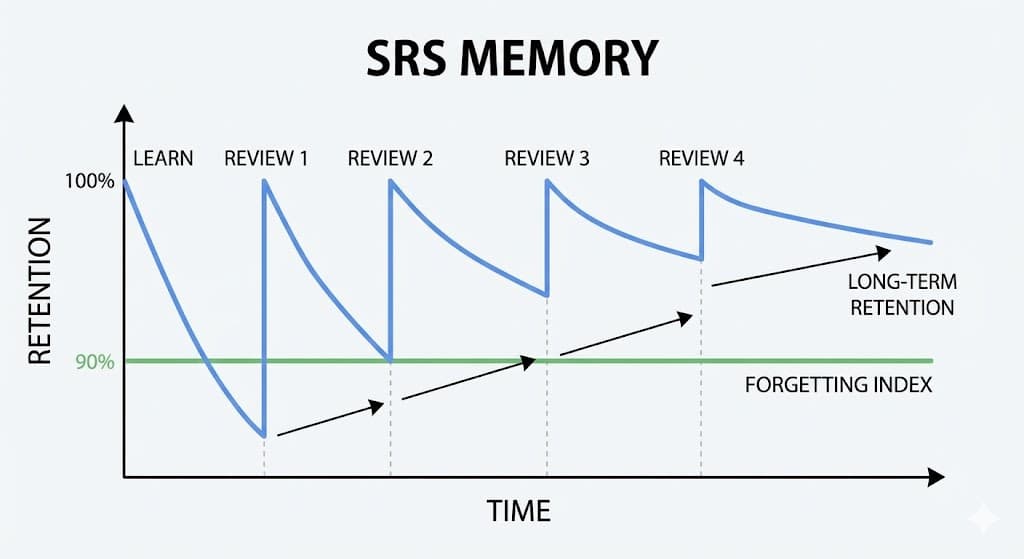
- Retrievability (R): Can you remember it right now? This number drops over time. When it hits your target (usually 90%), it's time to review.
2. What's Wrong with SM-2?
SM-2 has been the standard since 1987. It's in Anki, SuperMemo, and most flashcard apps. It works, but it has some annoying problems that FSRS fixes.
SM-2's Problems
- ×One size fits all: It treats everyone's brain the same. Your forgetting curve is unique, but SM-2 ignores that.
- ×Ease Factor Hell: Mark a card "Hard" a few times and it gets stuck in a loop. You'll see it every day forever. Super frustrating.
- ×Rigid intervals: Review a card early or late? SM-2 doesn't handle it well. The schedule gets messed up.
- ×Forgets your history: When you fail a card, SM-2 treats it like you've never seen it. All your previous learning? Gone.
How FSRS is Different
FSRS learns from YOUR reviews. It sees when you forget, when you struggle, and when things are easy. Then it builds a personalized model. The more you use it, the smarter it gets. No more ease factor hell. No more weird scheduling.
Studies show FSRS achieves the same retention with 20-30% fewer reviews. If you do 100 reviews a day, that's 20-30 you don't have to do. Over a year, you save weeks of study time.
3. How Does FSRS Actually Work?
Here's the simple version: FSRS uses math to predict exactly when you'll forget something, then schedules your review right before that happens. This is called the "desirable difficulty" principle—you learn best when you review at the edge of forgetting.
After each review, you rate the card: Again, Hard, Good, or Easy. Then FSRS does this:
- Checks how likely you were to remember (based on time since last review)
- Updates your memory strength based on your rating
- Adjusts the card's difficulty if you keep struggling or finding it easy
- Calculates exactly when you'll hit 90% chance of forgetting, and schedules the next review
4. How to Use FSRS Right
FSRS is powerful, but you need to use it correctly. Here's what actually matters:
1. Let it learn
FSRS gets smarter over time. Don't manually reschedule cards or mess with the settings. After about 1,000 reviews, it starts to really understand your patterns. Give it data and trust the process.
2. Set realistic retention
90% retention is the sweet spot for most people. That means you'll remember 9 out of 10 cards when tested. Going higher (95%+) sounds nice but doubles your workload. Not worth it unless you're studying for med school.
3. One fact per card
FSRS can't help you if your cards are too complex. Don't put "List the 5 causes of WW1" on one card. Make 5 separate cards. Simpler cards = better scheduling = less wasted time.
4. Review every day
Even 10 minutes daily beats one long session per week. FSRS models YOUR memory, and gaps mess up its predictions. Consistency is everything.
5. Don't fear the "Again" button
When you forget, just press Again. Unlike SM-2, FSRS doesn't reset the card completely. It remembers you've seen it before and adjusts accordingly. Failing is part of learning.
5. Common Questions
Q: Is FSRS harder to use?
A: Nope, it's easier. The math is complex, but you don't see any of that. Just review cards normally. The main difference you'll notice is fewer reviews and intervals that feel more natural.
Q: Can't I just use FSRS in Anki?
A: You can. But Anki added FSRS later, so the setup is complicated. Flica was built with FSRS from day one—no configuration needed. Just download and start learning with optimal scheduling.
Q: Is it good for language learning?
A: It's great for languages. Vocabulary has huge variation in difficulty—common words are easy, rare grammar is hard. FSRS handles this perfectly because it tracks difficulty per card.
Q: How long until it works well?
A: It works from day one with default settings. But after 1,000+ reviews, it starts personalizing. After 5,000+ reviews, it really knows your brain.
Q: Is this actually proven?
A: Yes. FSRS was tested on millions of real reviews and consistently beats SM-2 in prediction accuracy. It's based on real memory science, not guesswork.
6. The Bottom Line
FSRS is what spaced repetition should have been all along. It learns how your brain works, schedules reviews at the perfect time, and saves you hours of unnecessary grinding.
No more wrestling with complex settings. Flica has FSRS built-in, so just download and start. AI creates your cards too, so you can focus purely on reviewing.
Related Articles
References
- Ye, J. (2023). Free Spaced Repetition Scheduler (FSRS)
- Wozniak, P. A. (1990). Optimization of learning
- Ebbinghaus, H. (1885). Memory: A Contribution to Experimental Psychology
- Karpicke, J. D. (2008). The Critical Importance of Retrieval for Learning